

A New Era of Smart Healthcare: The medical industry is experiencing a technological revolution, and at the center of this change is Artificial Intelligence (AI). What once seemed impossible—machines helping diagnose diseases, generating prescriptions, or predicting health risks—has now become a reality. AI is not replacing doctors, but empowering them to provide faster, more accurate, and more personalized care.
1. AI Is Making Diagnosis Faster and More Accurate
Today, AI systems can analyze X-rays, MRIs, CT scans, and lab reports in seconds. They can detect subtle patterns that even trained specialists might miss.
From identifying early-stage cancer to spotting fractures or heart abnormalities, AI is acting as a second pair of expert eyes.
This doesn’t replace doctors—it enhances their decision-making and reduces chances of human error.
2. Automating Prescription Writing
One of the biggest time-consuming tasks for doctors is writing detailed prescriptions.
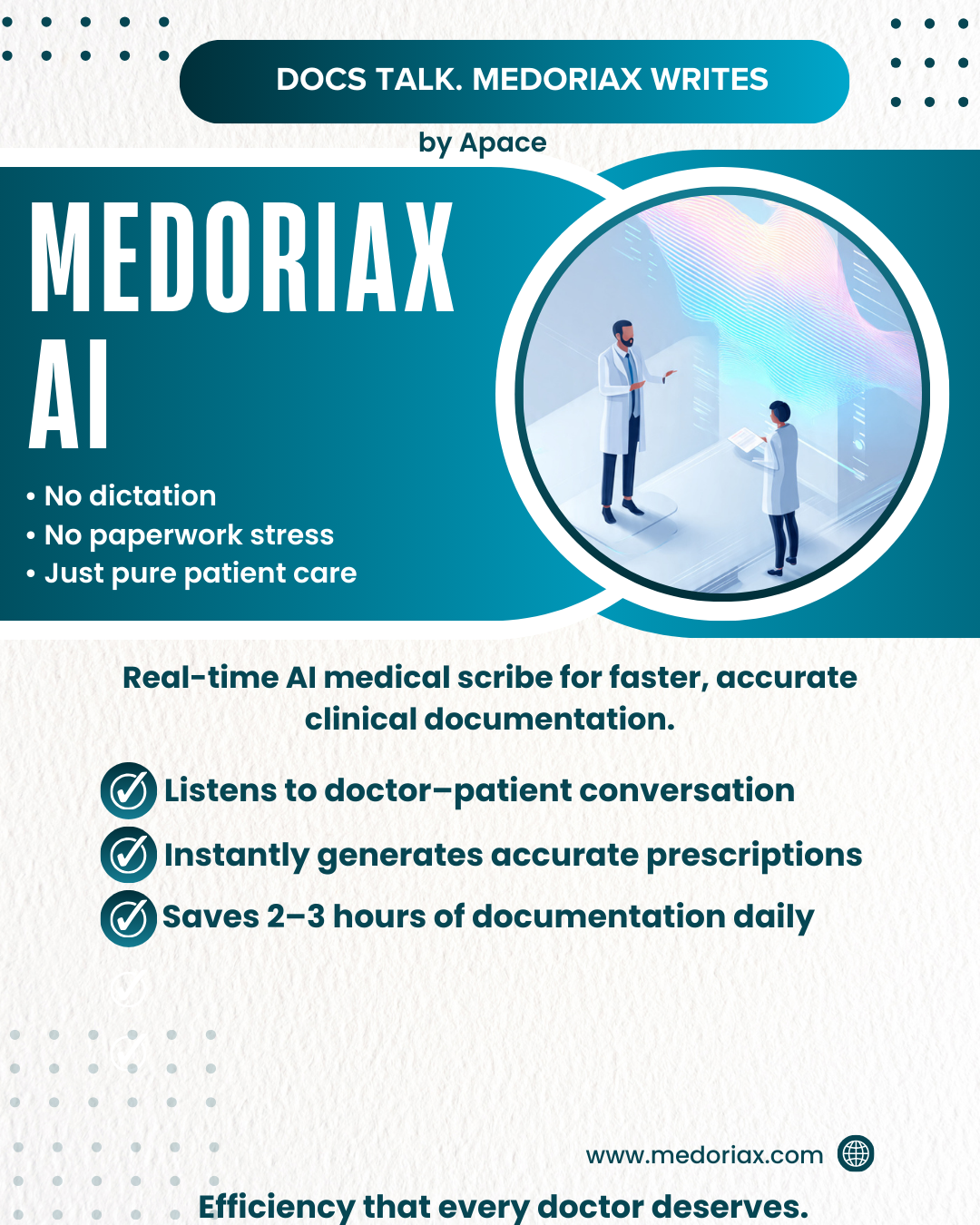
Modern AI tools—like the idea behind Medoriax—can listen to doctor–patient conversations, understand the symptoms, and automatically generate a clean and accurate prescription.
This saves the doctor’s time, improves clarity, and speeds up patient flow. Instead of spending 5 minutes per patient on writing, doctors can focus on actual care.
3. Smart Virtual Health Assistants
AI-powered chatbots and voice assistants are becoming a part of everyday healthcare.
They help patients with:
-
Symptom checking
-
Booking appointments
-
Medication reminders
-
Basic medical advice
This brings 24/7 support without needing to visit a clinic for minor queries.
4. Personalized Treatment Plans
Every patient is different, and AI helps doctors create customized treatment plans based on:
-
Medical history
-
Genetics
-
Lifestyle
-
Previous treatment responses
This approach—called precision medicine—increases effectiveness and reduces side effects. It ensures patients receive the treatment that suits them best.
5. Predicting Diseases Before They Happen
Wearable devices like smartwatches collect tons of health data.
AI can process this data to predict risks such as:
-
Heart attack
-
Diabetes
-
Stroke
-
High BP
By detecting early warning signs, AI helps in preventive healthcare, not just treatment.
6. Streamlining Hospital Operations
From billing to inventory management, AI is making hospitals more organized.
It automates routine tasks such as:
-
Patient record management
-
Pharmacy stock updates
-
Bed allocation
-
Emergency response coordination
This reduces administrative burden and ensures smoother patient care.
7. AI-Powered Surgical Assistance
In several advanced hospitals, AI-driven robotic systems assist surgeons with high precision.
These robots help in:
-
Minimally invasive surgeries
-
Delicate procedures
-
Faster recovery for patients
AI enhances accuracy and reduces complications.
8. Speeding Up Drug Discovery
Traditionally, developing a new medicine takes years. AI can analyze millions of molecular combinations in minutes, identify promising candidates, and reduce research time dramatically.
This was especially useful during the development of COVID-19 vaccines.
9. Remote Monitoring & Telemedicine
With AI-enabled devices, patients with chronic conditions can be monitored from home.
These devices track:
-
Sugar levels
-
BP
-
Oxygen
-
Heart rate
Alerts are sent instantly to doctors if something seems wrong, making healthcare more proactive and accessible—even in rural areas.
AI Is the Future of Healthcare
AI is not here to replace human doctors—it’s here to empower them.
The true value of artificial intelligence in healthcare lies not in automation, but in augmentation—giving clinicians supercharged tools that remove the burden of clerical work, enhance diagnostic accuracy, and support real-time decision-making. As AI handles routine documentation, analyses patterns invisible to the human eye, streamlines prescriptions, and ensures no detail is missed, doctors gain something they desperately need more of: time to focus on their patients.
With faster diagnosis, smarter triage, automated workflows, and personalized treatment recommendations, AI is helping create a healthcare ecosystem that feels more connected, more precise, and more patient-centric. Hospitals become more efficient. OPDs move smoother. Care becomes accessible even in remote corners of the country. And every doctor—whether in a clinic, hospital, or telemedicine platform—gets the support of a digital co-pilot working silently in the background.
AI represents not the end of traditional medicine, but the evolution of it—a shift toward a system where human expertise and machine intelligence work hand in hand.
The medical future is not just digital—it’s intelligent, collaborative, and built to serve every patient better than ever before.