
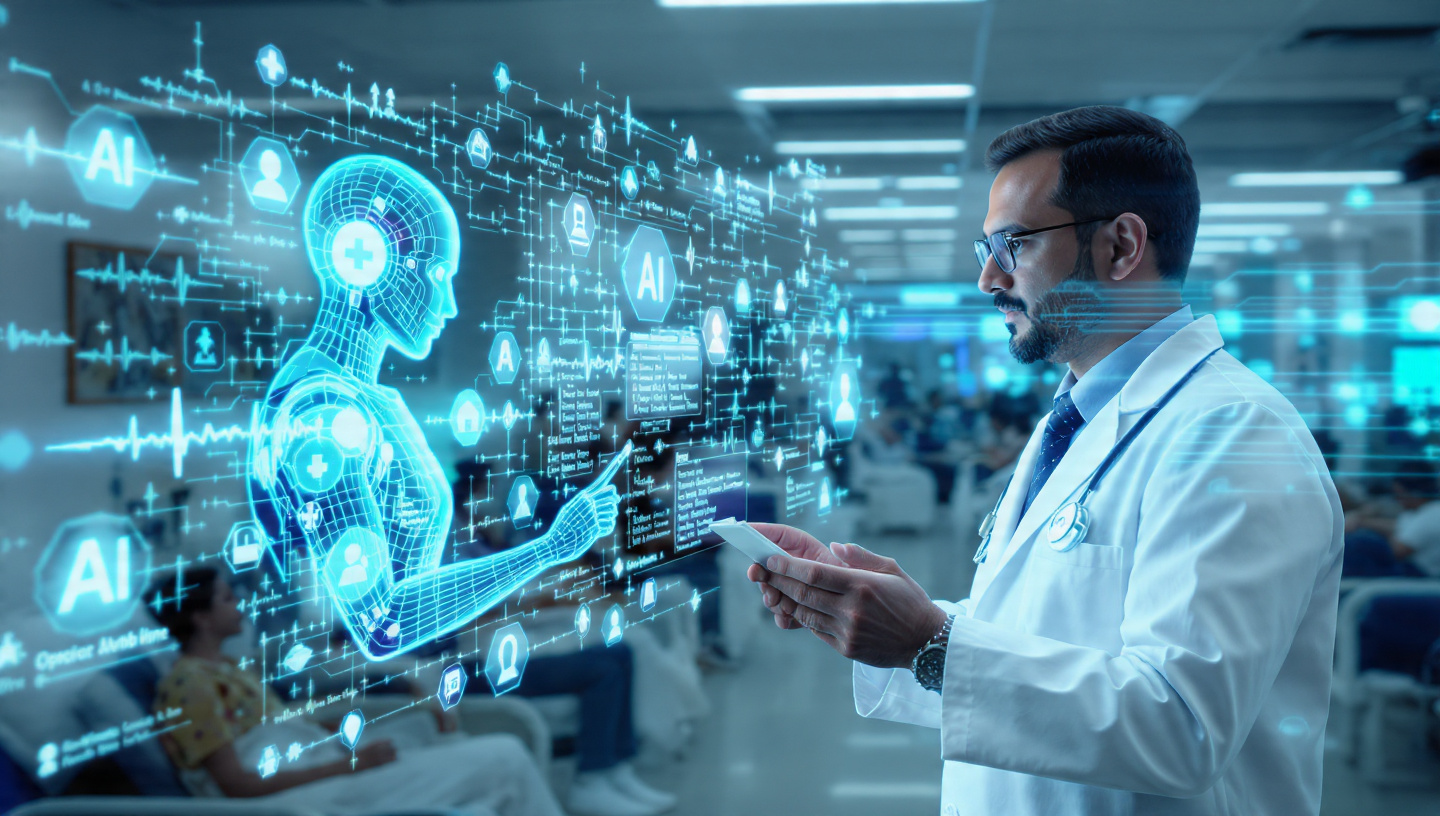

Over the past decade, India’s healthcare system has witnessed rapid digital transformation. While hospitals adopt EMRs and telehealth grows exponentially, one challenge still slows doctors down — clinical documentation. In a typical Indian OPD, a doctor often sees 80–120 patients a day, leaving very little time for typing SOAP notes, histories, and prescriptions. This gap created the demand for human medical scribes, but today, a new and more scalable solution is emerging: AI medical scribes.
This raises a powerful question that many avoid openly: Can AI truly replace human medical scribes in India — or is the truth more complex?
1. Understanding the Real Role of Human Medical Scribes in India
Human scribes have been a support system for doctors for years. Their work includes writing patient histories, updating EMRs, drafting SOAP notes, and even preparing discharge summaries. In India, scribes are often placed in busy cardiology, orthopedics, and general medicine OPDs to reduce typing load. Their presence helps doctors focus more on patient interaction rather than paperwork.
However, the Indian healthcare environment poses unique challenges. OPDs are crowded, staff turnover is high, and patient flow is unpredictable. Human scribes require months of training, they may misinterpret medical terms, and they can manage only one doctor at a time. These limitations created a gap that technology naturally stepped into — not to replace scribes immediately, but to enhance and scale the documentation workflow.

2. What Makes an AI Medical Scribe Different?
AI medical scribes use advanced speech recognition and medical language processing to convert doctor–patient conversations into structured clinical notes. Unlike general speech-to-text apps, medical AI understands symptoms, diagnoses, drug names, and clinical patterns. This is why platforms like Medoriax AI can generate SOAP notes, extract patient vitals, and even assist in prescription creation.
What makes AI scribes particularly suited for India is their ability to understand accents, switch between English and Hindi, and process conversations fast. This reduces dependency on human assistants and allows clinics to maintain accurate digital documentation without increasing staffing costs. AI also provides consistency: whether it’s the first patient of the day or the hundredth, the quality of documentation remains the same.
3. Why India Is Becoming the World’s Fastest-Growing AI Scribe Market
India offers a unique environment where AI scribes can flourish faster than in Western countries. For one, patient loads are much higher here, making manual documentation nearly impossible. Doctors often finish OPD hours feeling mentally drained because they spend additional evening hours completing paperwork. AI scribes solve this by generating notes instantly, saving 1–2 hours per day.
Another reason is affordability. Small clinics and nursing homes cannot hire a full-time scribe for every doctor, but they can easily adopt a low-cost AI solution. Indian doctors also prefer voice communication — from WhatsApp voice notes to dictating instructions to staff — making the shift to AI voice scribing natural and intuitive. Combined with India’s push toward digital health and ABDM integration, AI scribes are becoming a necessity rather than a luxury.
4. Will AI Replace Human Scribes? Here’s the Balanced Truth
The idea that AI will “replace” human scribes sounds dramatic, but the reality is more nuanced. AI can automate the repetitive, time-consuming documentation tasks, but certain aspects of medical note-taking still benefit from human understanding. Human scribes can pick up on gestures, environmental cues, or emotional tones that AI still struggles with. For example, a patient pointing to a body part without describing it requires human interpretation.
However, research shows that AI can replace around 70–80% of scribe duties with high accuracy. This includes transcription, note structuring, prescription preparation, and EMR updates. The remaining 20–30% requires human judgment or doctor verification. As a result, AI scribes aren’t eliminating the role — they are transforming it into a supervision and quality-checking position instead of manual typing.
5. Strengths of AI Scribes Compared to Human Scribes
AI scribes excel in areas where humans commonly struggle in clinical settings. They can process large volumes of speech instantly, maintain consistent accuracy, and remain available 24/7 without fatigue. Their cost-effectiveness is a major advantage, especially in India.
Another important strength is data privacy. Patient information handled by humans can be vulnerable, but encrypted AI systems reduce exposure. AI does not get distracted, emotional, tired, or overwhelmed — making it highly reliable in high-pressure environments.
Still, doctors prefer having the ability to edit or review AI-generated notes. Platforms like Medoriax AI incorporate this by allowing quick modifications before saving the record. This hybrid model gives the best of both worlds — AI speed and human verification.
6. Limitations: Where Human Scribes Still Perform Better
Despite advancements, AI scribes are not perfect. They struggle with strong background noise, unclear speech, or mixed-language sentences that lack structure. Human scribes can also understand complex contextual clues, like patient gestures or emotional expressions, which AI cannot analyze yet.
In rural or small-town clinics where OPDs are chaotic, environmental challenges may reduce AI accuracy. Additionally, older doctors who are less comfortable with technology may prefer human assistance initially. This shows that while AI is a strong replacement, human oversight still plays a role in ensuring complete accuracy.
7. A Hybrid Future: The Most Realistic Outcome
Most healthcare experts agree that the future is hybrid. AI will perform the heavy lifting — transcription, structuring, summarizing — while humans (or doctors themselves) will review and finalize notes. This model enhances productivity without compromising safety or accuracy.
Large hospitals in the US and India have already adopted this approach. AI handles documentation, and a small medical records team verifies and syncs the final notes. Clinics using Medoriax AI follow the same model, where AI generates SOAP notes instantly and doctors make minor edits before saving. This ensures both efficiency and reliability.
8. Why Indian Doctors Are Rapidly Adopting AI Scribes
In interviews with Indian doctors, several benefits of AI scribes consistently appear. Doctors report saving 40–60% of their daily documentation time, enabling them to see more patients while reducing mental fatigue. The AI-generated notes are more structured than handwritten or shorthand entries, improving clinical quality.
Another benefit is transparency. Every conversation is captured and documented, reducing medico-legal risks. Clinics also appreciate the reduction in staff dependency and operational costs. Over time, AI scribes create a rich digital record of patient visits, contributing to better long-term care and analytics.

9. So, Will AI Replace Human Medical Scribes in India?
The most accurate answer is: AI will replace most scribe tasks, but not all human involvement. Instead of typing or listening manually, humans will shift toward reviewing and improving AI output. This is similar to how accountants now use software but still provide expertise, or how photographers use AI editing tools but add creative judgment.
AI scribes like Medoriax AI are already handling transcription, SOAP note generation, prescription draft creation, and clinical summary extraction with high accuracy. These systems are improving rapidly with machine learning, benefiting directly from Indian clinical data patterns. Over the next 5–7 years, AI will perform nearly all documentation tasks, but doctors will still hold the final authority.
10. Final Conclusion
AI medical scribes are not replacing human scribes overnight, but they are undeniably transforming clinical documentation in India. They reduce workload, cut costs, and improve accuracy. In an environment where doctors are overwhelmed by patient volume, AI scribes are becoming essential tools that allow clinicians to focus on what truly matters — patient care.
Human scribes will remain relevant but in evolving roles, mainly reviewing AI output or assisting with complex cases. The future is not AI vs human; it is AI + human, working together to deliver faster, safer, and smarter healthcare documentation.
And as solutions like Medoriax AI continue advancing, India is positioned to become one of the leading adopters of AI-powered medical documentation globally.